How to Read Drum Sheet Music: A Beginner's Guide
Drum sheet music looks strange the first time you see it. There's no treble clef, some notes are drawn as little x's, and two rhythms seem to be stacked on top of each other. The good news: drum notation doesn't tell you which pitch to play, it tells you which drum to hit. Once you know which line or space belongs to which part of the kit, you're already halfway there.
This guide walks through the basics in the order you'll actually need them, with examples you can read along with.
The staff shows drums, not pitches
The two thick vertical bars at the start of the staff are the percussion clef. They tell you this staff is a map of the drum kit, not a range of notes. A note on a given line or space always means the same drum, all the way through the song.
The shape of the notehead tells you what kind of instrument it is:
- Round noteheads are drums: snare, toms and kick
- x noteheads are cymbals: hi-hat, ride and crash
That one rule clears up most of the confusion on a first look.
Where each drum sits on the staff
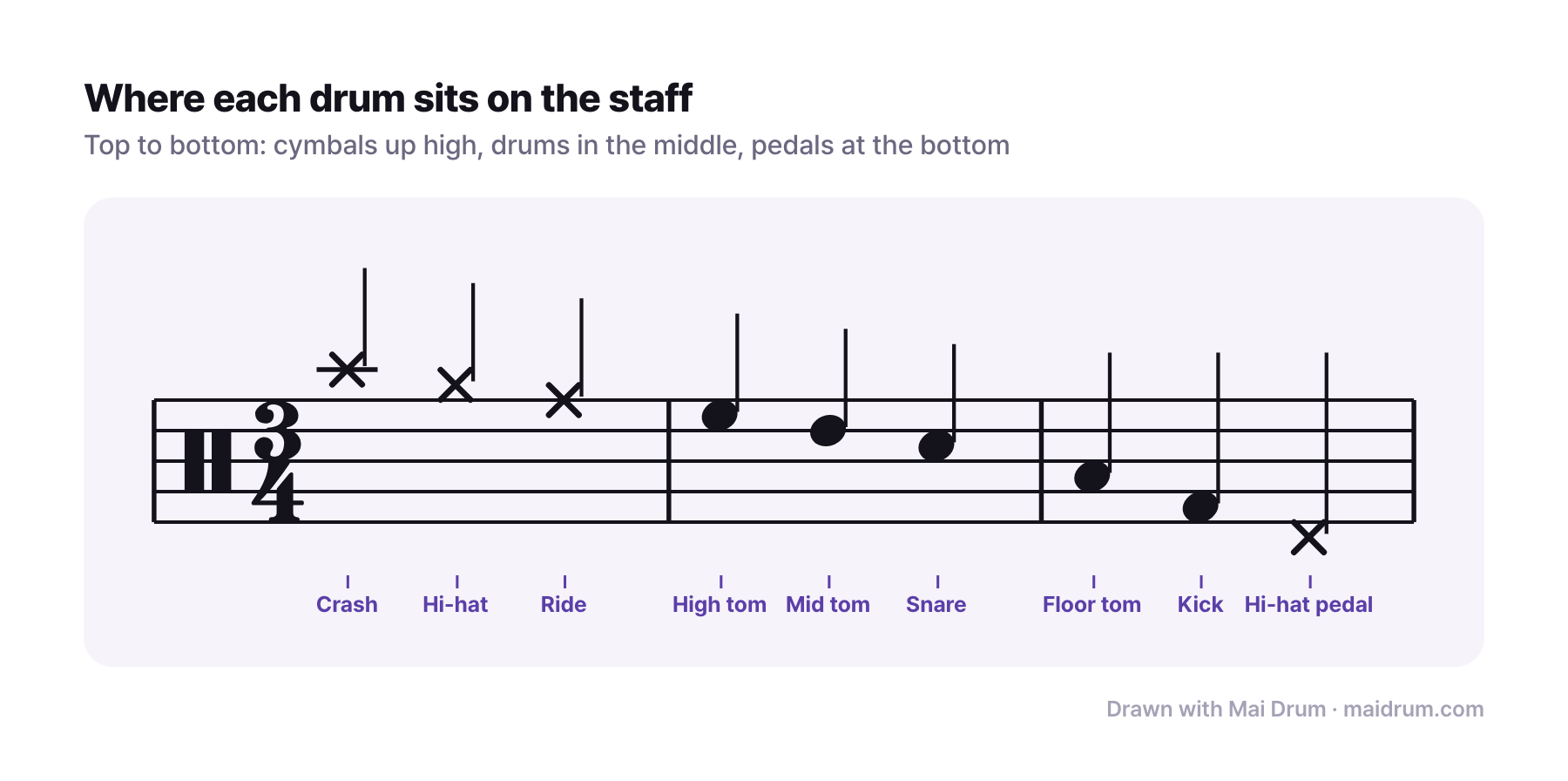
Here is the most common layout, from top to bottom:
- Crash cymbal: x on a ledger line above the staff
- Hi-hat: x in the space just above the staff
- Ride cymbal: x on the top line
- High tom: the top space
- Mid tom: the second line from the top
- Snare drum: the third space from the bottom
- Floor tom: the second space from the bottom
- Kick (bass drum): the bottom space
- Hi-hat pedal: x just below the staff
An easy way to remember it: the higher an instrument sits on a real kit, the higher it sits on the staff. Cymbals are up top, drums fill the middle, and anything you play with your feet lives at the bottom.
Publishers don't all agree on the toms (and sometimes the ride), so when you open a new method book or chart, look for the drum key near the front. It takes ten seconds and saves a lot of guessing.
Stems: hands up, feet down
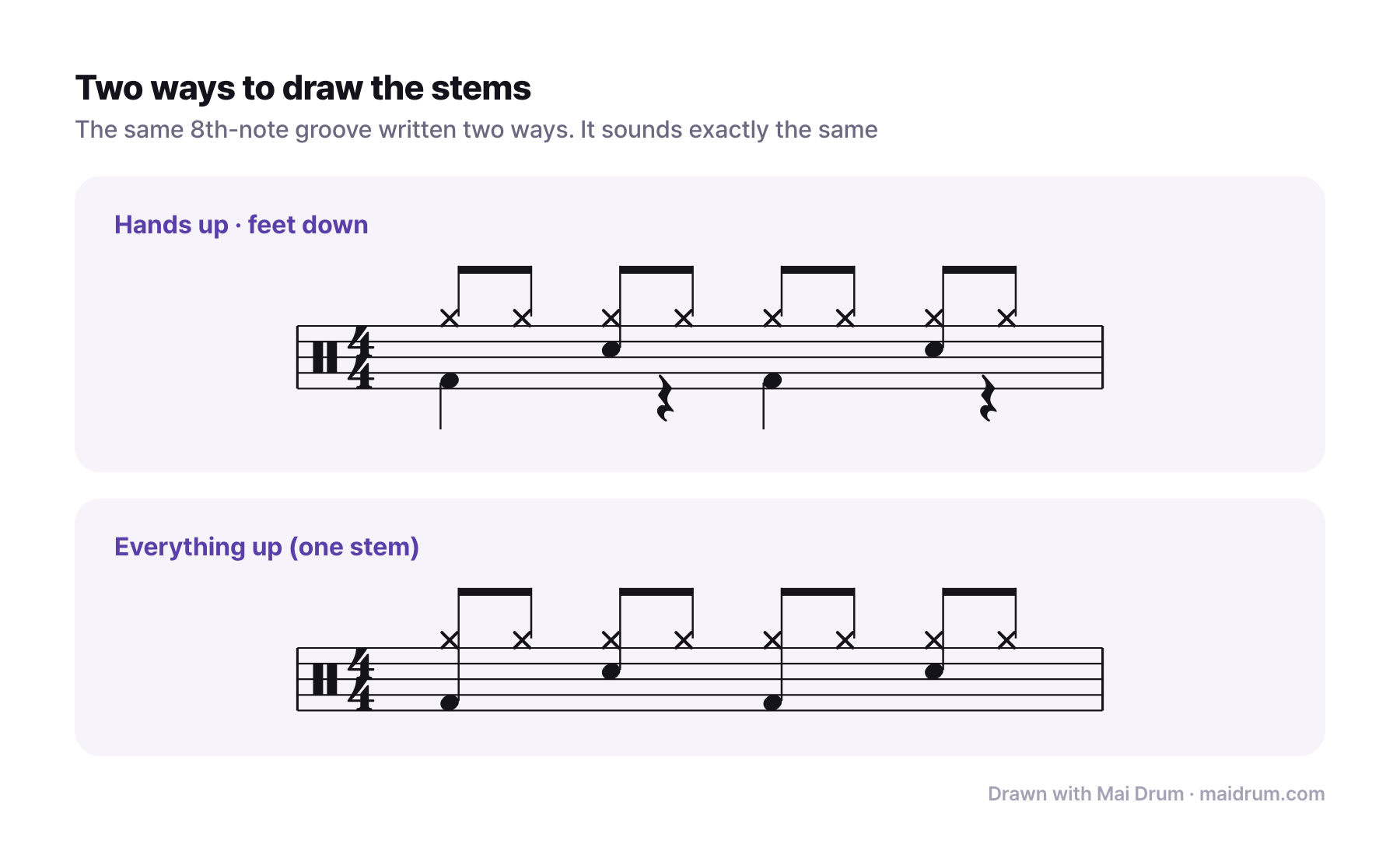
In most drum charts, notes played with your hands have their stems pointing up, and notes played with your feet have stems pointing down. In a basic groove, that means hi-hat and snare stems go up while the kick drum hangs below.
Splitting the parts this way lets you see at a glance what your hands and feet are doing. You'll also see plenty of charts that put everything on one set of stems pointing up. It sounds exactly the same, it's just drawn differently, so it's worth getting comfortable with both.
Read your first rock beat
Let's read the groove almost every drummer learns first. It's in 4/4, which means four beats per bar. Count the eighth notes out loud: "1 & 2 & 3 & 4 &."
- Hi-hat: eight x's across the top, one on every count
- Snare: on 2 and 4, the backbeat
- Kick: on 1 and 3
Say it as "boom, tss, crack, tss, boom, tss, crack, tss" and you're playing it. When you get to sixteenth notes, split each beat into four instead of two: "1 e & a, 2 e & a."
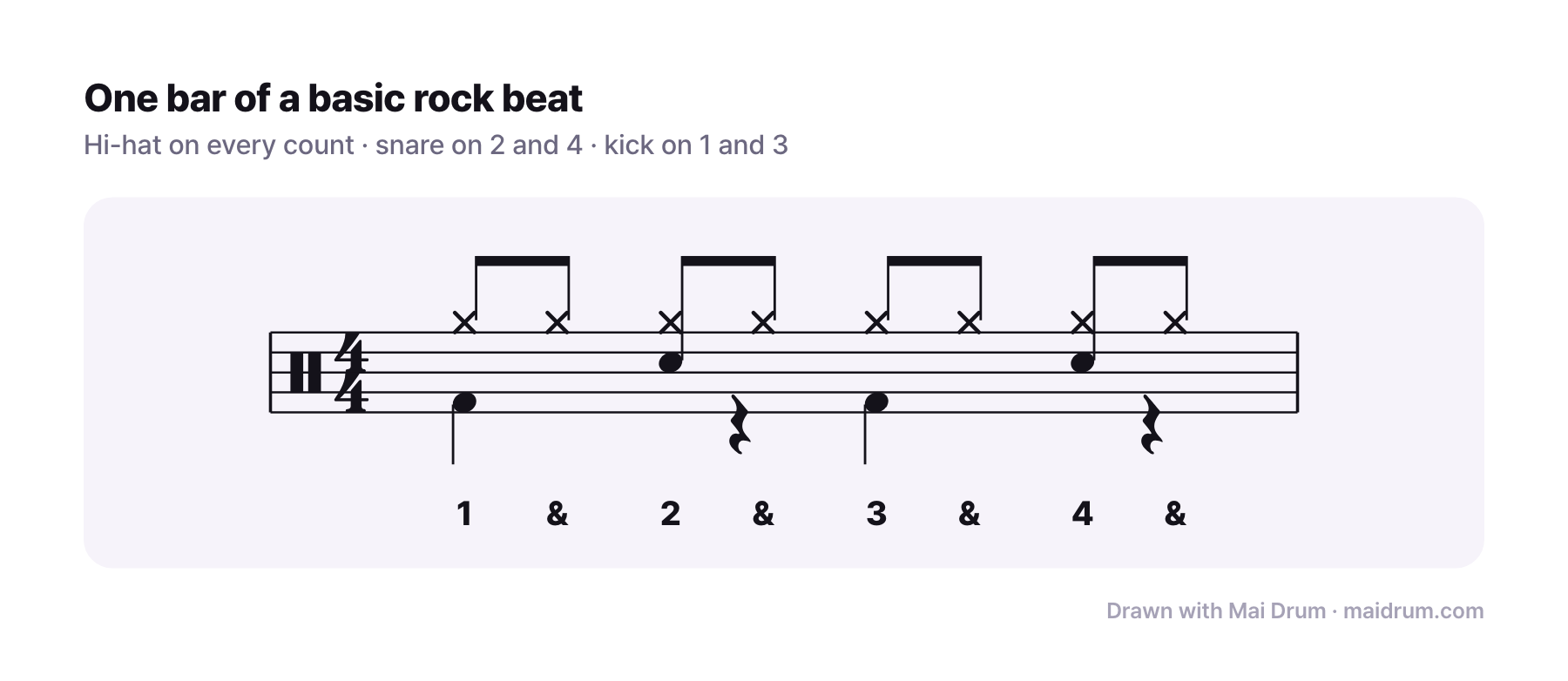
Notice the little squiggles under the snare hits. Those are rests in the foot part. They don't mean you stop playing; they just show that your feet aren't doing anything on that beat while your hands keep going.
Three symbols you'll see everywhere
- Accent ( > ): play that note louder than the ones around it
- Ghost note ( note in parentheses ): play it very softly, more felt than heard
- Open hi-hat ( small circle ○ ): lift your foot slightly so the hi-hat rings open. A small + means close it again
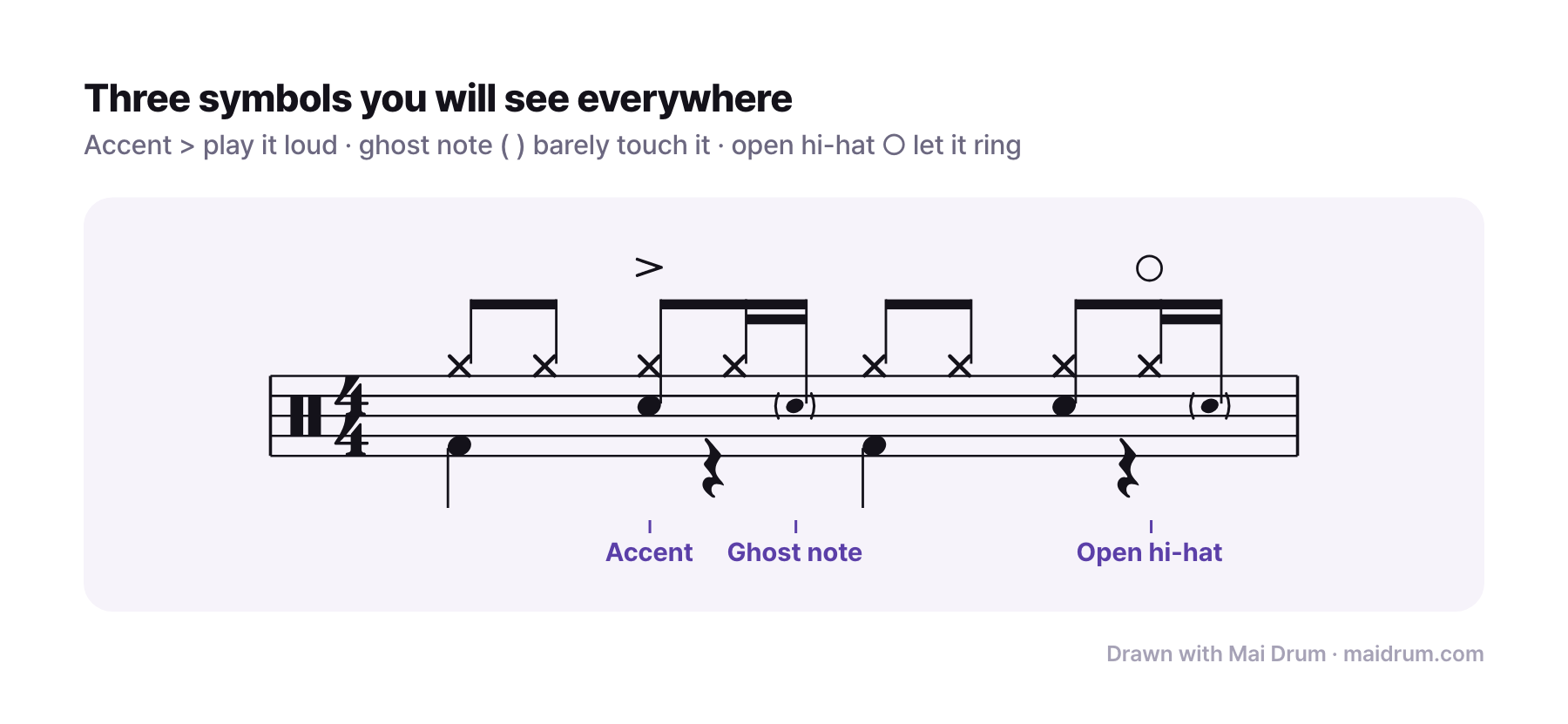
With these three, you can read most of the beginner and intermediate grooves you'll come across.
How to get faster at reading
- Count out loud. It feels silly, but it locks the rhythm in faster than anything else
- Go slow with a metronome. Read it correctly at 60 BPM before you try it at song tempo
- Write it yourself. Copying a groove onto the staff, by hand or in an app, teaches you more than reading ten of them
Every example in this post was drawn in Mai Drum, a drum notation tool where you tap a grid and it turns into a score you can play back. It runs free in your phone's browser, so you can write out the groove above and hear it right away.