How to Count 16th Notes on Drums (1 e & a)
Eighth notes are easy to count: "1 & 2 & 3 & 4 &." The moment a chart has sixteenth notes, though, a lot of drummers start guessing. The fix is a counting system that gives every sixteenth note its own name, so you always know exactly where you are in the bar.
That system is "1 e & a." Say it "one-ee-and-uh," and you'll hear it in almost every drum lesson in the world.
Four syllables per beat
In 4/4, each beat splits into four sixteenth notes. Each one gets a syllable:
- 1 is the beat itself
- e is the second sixteenth
- & is the halfway point, the same spot as the eighth-note "and"
- a is the last sixteenth, just before the next beat
Then the next beat starts: 2 e & a, 3 e & a, 4 e & a. Sixteen syllables, sixteen notes, one bar.
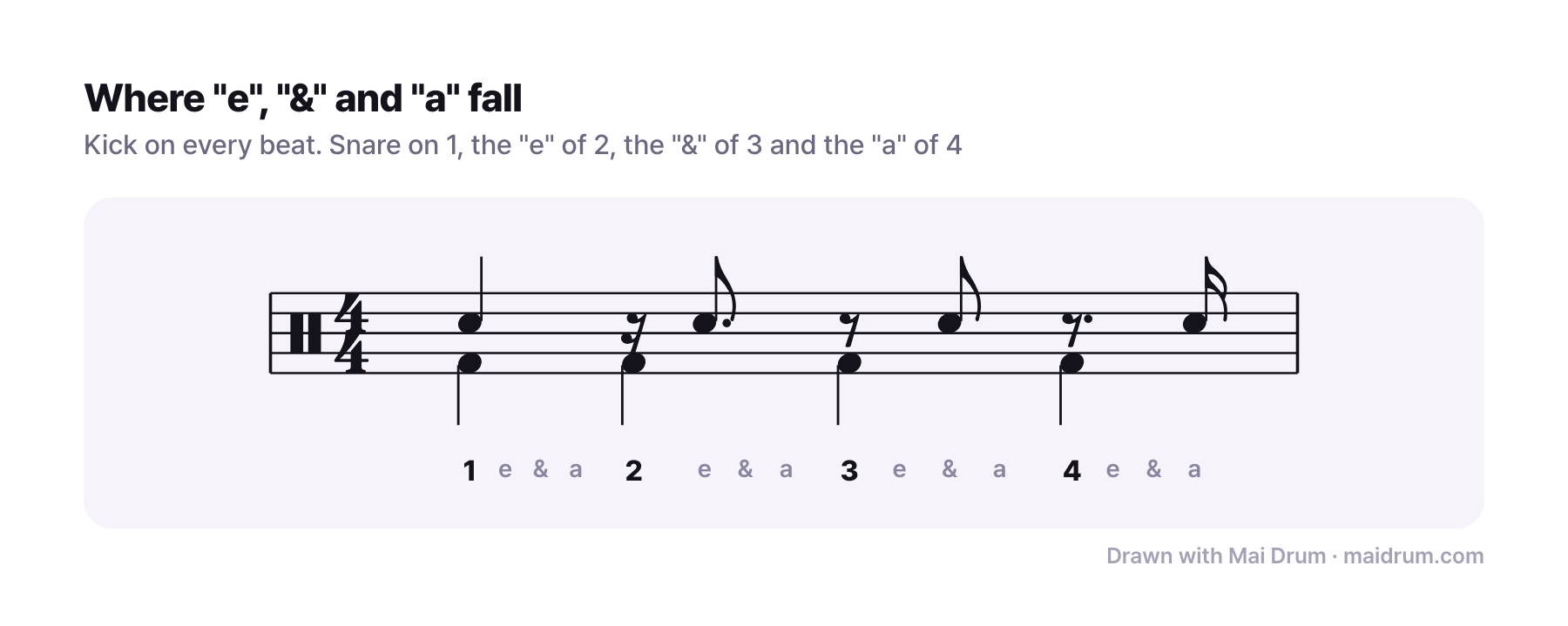
Here the kick marks every beat so you can see where each count sits. The snare hits once in each beat, but on a different syllable each time: 1, the e of 2, the & of 3, and the a of 4. Notice the rests in front of the later snare notes. They're there because those notes don't start on the beat.
Sixteenth notes on the hi-hat
Now play a full bar of sixteenths on the hi-hat, with the snare on 2 and 4 and the kick on 1 and 3. Count every single note out loud.
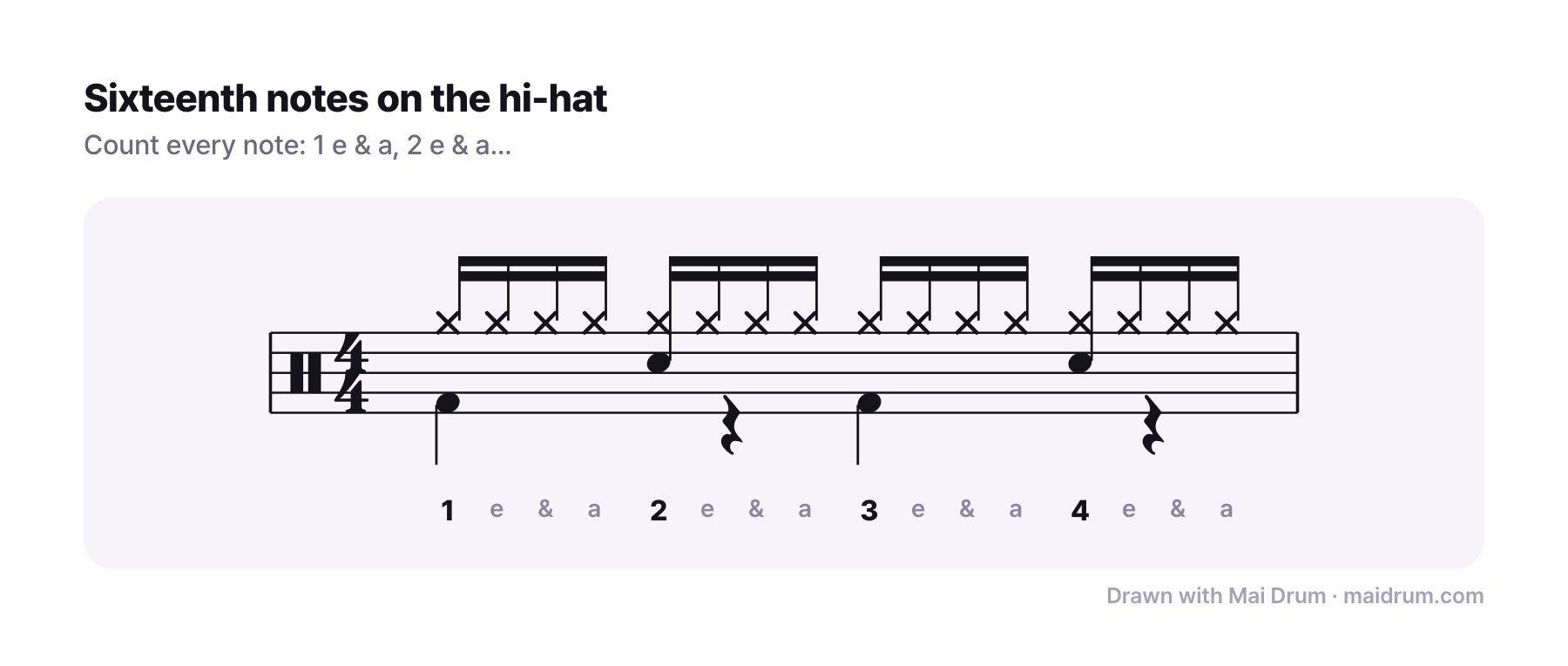
The snare lands on "2" and "4," never on an "e" or an "a." If you count while you play, you'll feel each backbeat land on a big number. That's the anchor you'll come back to every time the rhythm gets busy.
Eighths on top, sixteenths underneath
This is where counting really pays off. Very often the hi-hat plays eighth notes while the kick plays sixteenth-note patterns. The hi-hat only tells you the "1 & 2 &," so you have to keep the "e" and "a" going in your head.
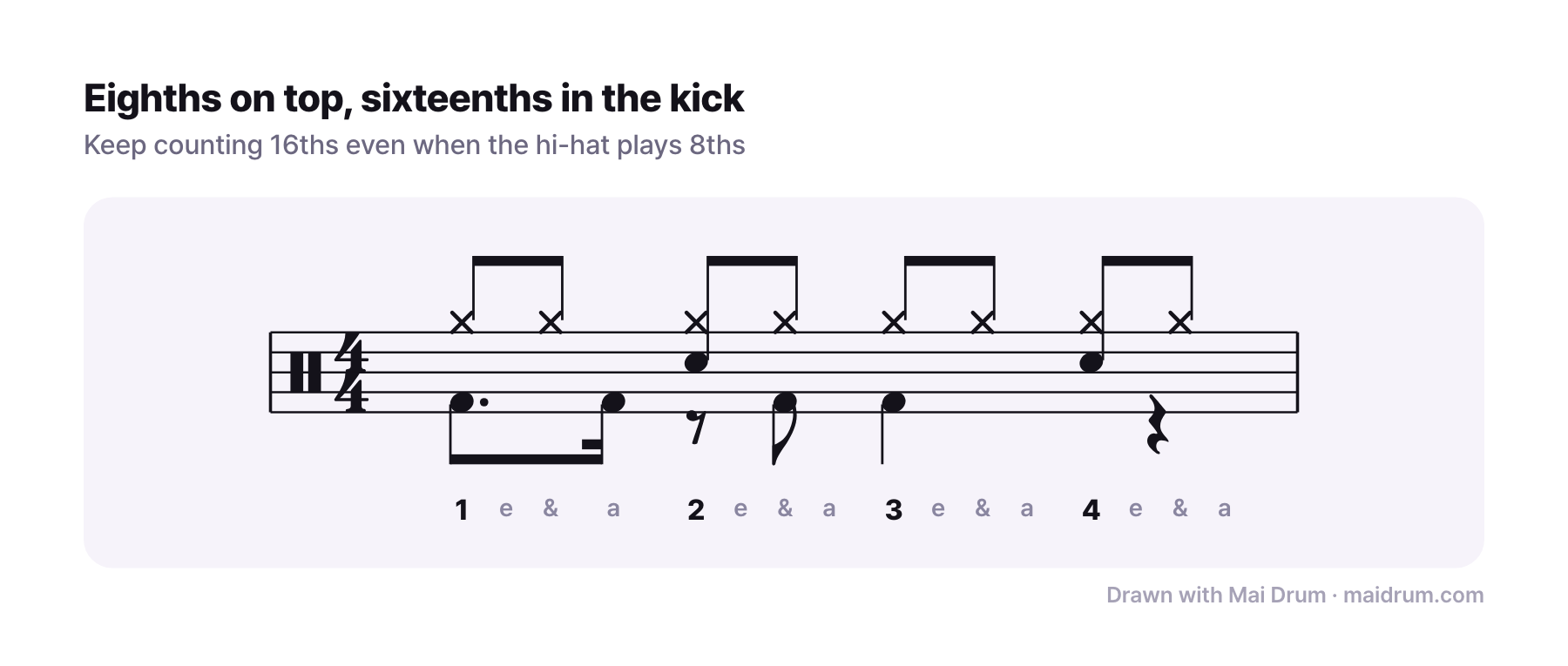
Here the kick plays on 1, the a of 1, the & of 2 and 3. The note on "a" is the tricky one: it comes right before beat 2, so it feels like a push into the snare. Count the full "1 e & a" out loud and it stops being tricky.
How to practise counting
- Count out loud, every time. Whisper it if you have to. Counting in your head lets you skip notes without noticing
- Start slow. Sixteenth notes at 60 BPM are four notes per second, which is plenty while you learn
- Clap first, then play. Clap the rhythm while counting, then play just one limb, then add the others
- Say the rests too. If a note is on the "a," say the "1 e &" quietly and the "a" loudly. You'll never lose the beat
Once "1 e & a" is automatic, a lot of rhythms that looked complicated turn out to be the same few shapes in different places.
The examples above were written in Mai Drum. Tap a sixteenth-note pattern into the grid, press play, and count along with it; it's free in your phone's browser. For a refresher on the staff itself, see How to Read Drum Sheet Music.